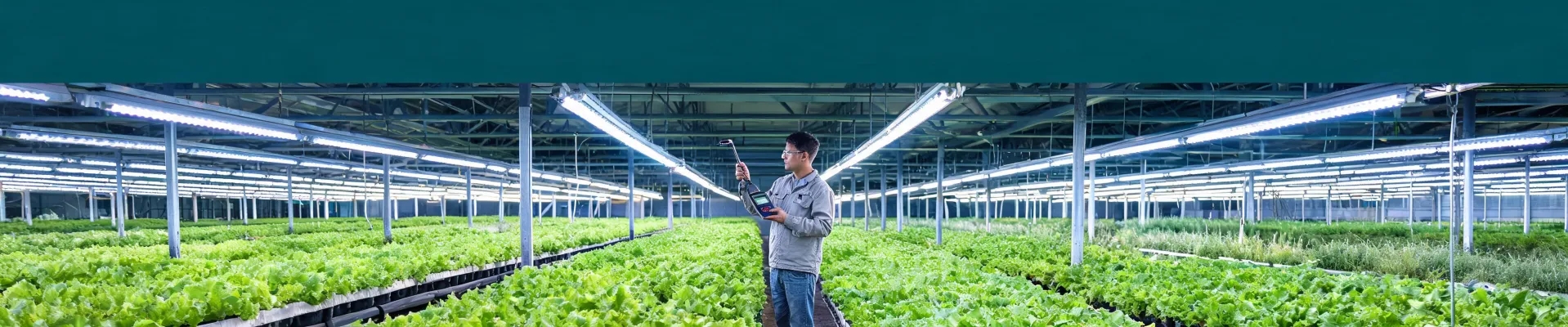
As a quality and brand compliance manager in the horticultural lighting industry, I review every fixture that ships under our name—roughly 200+ SKUs a year. Over four years of this work, I've landed on a conviction that might surprise you: there is no single "best" way to source grow lights. There's only the right route for your specific situation.
In practice, I see three routes: buying complete branded Gavita grow lights for your own greenhouse, building your own brand through OEM or private label, or selecting commercial fixtures from a ceiling light catalog. Each leads to a different decision. Let me walk through them and then help you pinpoint which one you're in.
Scenario 1: The lights stay in your own greenhouse
If you're a commercial grower and the fixtures will be installed in your own facility, you're not sourcing a product to resell—you're buying a long-term tool. That changes how you should evaluate quotes.
Most buyers in this situation focus on the per-fixture price and completely miss the cost of spec non-compliance. I've seen batches of "equivalent spec" fixtures where actual measured photon output ran 15–20% below the datasheet within the first year. That's not a guess; that's what third-party photometric testing showed when we ran side-by-side comparisons.
If you ask me, a Gavita LED grow light from the Pro or RS line—or the CT series for greenhouse applications—is the answer here. We built those lines for different mounting heights and canopy types: the Pro series for higher-ceiling installations, the RS series for lower-profile layouts, and the CT series for greenhouse top-light positions. Every fixture ships with documented performance data: PPF, spectral distribution, and thermal behavior. You're buying the documentation as much as the hardware.
One thing I'd add as a side note (note to self: this deserves a full article someday): growers focus heavily on headline PPF numbers and completely miss spectral uniformity across an array. Two fixtures can show the same PPF and perform very differently in a real greenhouse layout because of how the light spreads. Ask for intensity distribution data, not just the headline number.
There's also a compliance layer that people overlook. If you're a commercial operation, your lighting may need to meet specific program requirements. DLC's horticultural lighting qualified products list is a good reference here—it requires photometric testing under LM-79 standards. If a supplier can't produce a current LM-79 report when you ask, that's a red flag I'd take seriously.
Scenario 2: You're building a brand — OEM vs. private label
This is where greenhouse lighting sourcing gets more strategic. You're not the end user; you're a distributor, an agricultural retailer, or an entrepreneur who wants to sell grow lights under your own name. The first decision isn't about fixtures at all—it's about OEM versus private label.
Let me clarify the distinction, because plenty of people blur it: OEM means you're commissioning a manufacturer to build a product to your specifications—custom drivers, thermal design, optics, housing. You own the spec and the engineering responsibility. Private label means you're buying an existing product design and putting your brand on it. The manufacturer handles engineering; you handle sales and marketing. Your control over the hardware is limited to choosing which models to carry.
What most people don't realize is that private label isn't a shortcut to owning a product line. In our Q1 2024 quality audit, we looked at several private label products from new market entrants that had zero internal quality control—importing finished goods and putting their logo on the box. When field failures started, those brands had no failure-analysis capability, no supplier leverage to force corrections, and no documentation trail. Their resellers absorbed the damage.
Here's something vendors won't tell you: the first quote is rarely the final price for an ongoing relationship. There's usually room to negotiate once you've proven you're a reliable buyer. But at the same time, a lower unit price only makes sense if you've verified the supplier's quality system. Otherwise the "savings" become your liability the first time a batch fails.
Even after we signed off on a strategic OEM partner a few years back, I kept second-guessing. What if their QC slipped once we were deep into production? The first three months of deliveries were stressful. I didn't relax until we'd completed three consecutive batch audits with zero failures (thankfully, that's exactly what happened).
There's also the certification side to weigh. Whatever brand name is on the fixture, compliance responsibilities—UL/ETL listing, DLC qualification, energy regulations—fall on the party bringing the product to market. For private label, that's you. Confirm who holds the certifications, what jurisdictions they cover, and what happens if an inspection flags something.
Scenario 3: You're shopping a ceiling light catalog
This is a different lane, but it shows up constantly in our space. A property developer, fit-out contractor, or facility manager needs commercial ceiling lighting—recessed downlights, track fixtures, suspended luminaires—and lands on a ceiling light catalog that happens to include both horticultural and architectural lighting.
If you're here, the keyword isn't "photosynthesis." It's consistency. When you order 400 recessed fixtures for a retail rollout, every unit needs to look and perform identically. Not approximately. Identically.
We built a verification protocol in 2022 to deal with exactly this: batch-testing finished stock at regular intervals—photometry, driver behavior, and visual finish. It isn't glamorous work (ugh, the spreadsheets), but it's the only way to catch drift before customers do. I learned the hard way to never assume a datasheet represents the production line. Two suppliers can claim the "same specification" and deliver very different results once you measure them. The protocol caught several issues that would have shipped undetected, and it paid for itself every time.
I'm not 100% sure of the industry-wide number, but based on our incoming inspections and competitive teardowns, roughly 8–10% of budget ceiling fixtures from non-certified suppliers don't meet their own published specs when tested independently. Take that with a grain of salt—it's anecdotal, not a published study—but it's a directional warning.
The rule for ceiling light catalog purchases is simple: if the manufacturer doesn't publish photometric data, warranty terms, and driver specifications in a downloadable format, treat that as a warning sign. Manufacturers with real testing infrastructure publish their reports because they're proud of them.
How to determine which scenario fits you
Use these three questions as a quick self-diagnosis:
- Whose name is going on the fixture? If it's yours, you're in Scenario 2—the OEM vs. private label decision.
- Are the lights staying in your own greenhouse? If yes, you're in Scenario 1—buy the complete, documented fixture.
- Are you lighting a commercial space that doesn't grow plants? Then you're in Scenario 3—shop the ceiling catalog, but verify the specs before you commit.
Still uncertain? Here's a fairly reliable tell: if your question is "which fixture should I buy?" you're a grower. If it's "should I sell this under my own brand?" you're a distributor or OEM buyer. If it's "do these come in a 4-inch and 6-inch option?" you're a commercial buyer.
The real cost of getting it wrong
Let me end with a story. In 2023, we received a fixture batch where the color rendering index was visibly off—82 measured against our 90+ spec, with a normal tolerance of ±2. The vendor argued it was "within industry standard." We rejected it, and they redid the batch at their cost. Now every contract we sign includes CRI requirements and third-party verification rights.
That defect set us back $22,000 in rework and delayed a customer launch by three weeks. The buyer had chosen the vendor because their quote was $4,000 lower than ours. After rework, delay, and expedited shipping, they were roughly $31,000 deeper than if they'd bought the compliant product at the outset.
The math is why I'm such a believer in value over price. The unit price is only the entry point. Total cost includes spec compliance, batch consistency, documentation, and the warranty you'll only need if something goes wrong. The cheapest quote in greenhouse lighting sourcing is rarely the cheapest outcome.
Personally, I'd rather pay for certainty. But that's the quality inspector in me talking.

Clara Whitmore
Clara Whitmore is a lighting photometry and LED source analyst specializing in bulbs, tubes, strips, panels, and integrated luminaires. She interprets IES LM-79 measurements and TM-30 color rendition data through luminous flux, efficacy, intensity distribution, CCT, chromaticity, fidelity, and gamut metrics. She writes evidence-led comparisons for specifiers selecting source formats and luminaires for commercial interiors, industrial spaces, or horticultural systems where measured optical and color performance matter.