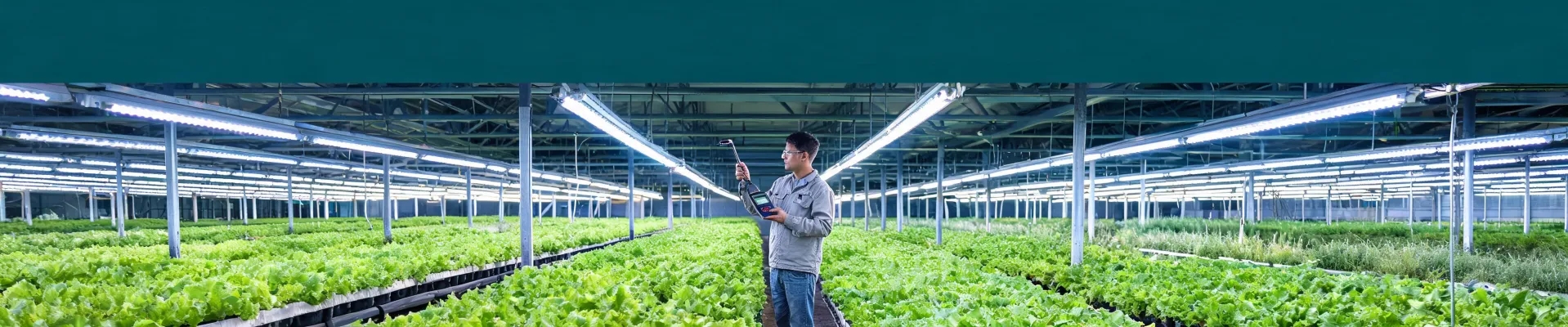
I'm the quality and brand compliance manager at a lighting distributor. Every SKU in our catalog crosses my desk before it reaches a customer — roughly 200 items a year, across two very different product families: horticultural LED fixtures and commercial architectural lighting. In 2025, I rejected about one in five first-article submissions for something that didn't match the spec sheet we'd been handed.
So when a buyer asks me "which grow lights should we order," or "where do we source bulk downlights and spotlights without getting burned," I don't give them one answer. Not to be diplomatic. Because the right answer changes depending on which of three situations they're actually in.
- Scenario A: You're the end user, and the lights you buy run your production.
- Scenario B: You're buying for a commercial project or reselling under your own brand, and the fixture is someone else's first impression of your company.
- Scenario C: You're a distributor or a multi-site operator, and you need both — plus documentation that survives an audit.
Same catalogs. Three different purchase decisions. Here's how each one plays out.
Scenario A: The lights run your production
Grow room, greenhouse, propagation rack. If a fixture underperforms here, you don't find out for weeks — you find out in the crop, when the cheap decision is no longer available to you.
What goes on the spec sheet: PPF, photon efficacy in µmol/J, spectrum, and the safety listing. Not "high output." Not "full spectrum." Numbers a lab signed off on, with a test report you can actually open. ANSI/ASABE S640 is the standard that defines how plant-lighting quantities are named and measured, so a vendor can't quietly redefine "output" to mean something convenient. Verify the current revision before you write it into a purchase order.
Two compliance items that get skipped more often than you'd think:
- The safety listing. Horticultural fixtures sit in a different category than general lighting. UL 8800 covers horticultural lighting equipment; if your fixture isn't listed, your insurance carrier may have opinions about that after a fire rather than before one. Verify the current edition and listing status at ul.com.
- Rebate eligibility. The DLC's Horticultural Lighting Technical Requirements (designlights.org) determine which fixtures qualify under many utility programs. Check the current qualified products list — versions change, and a fixture that qualified last cycle may not this one.
Where a brand like Gavita fits: the reason the catalog splits into Pro, RS, CT, UV bars, Clone Bars, and under-canopy fixtures is that those solve different positions in the room. A Gavita Pro 1700E Gen 2 LED Grow Light and a 40-watt under-canopy bar are not interchangeable, and buying the big fixture for a slot where a bar would do is how grow-room budgets get wrecked. Buy the position, not the spec sheet. If you're comparing Gavita grow lights against other spec-grade fixtures, that's the comparison that matters — published data against published data.
Here's the part that goes against the usual advice. Don't buy the fixture with the best number on the page. Buy the fixture whose numbers you can verify. I've sat in meetings where two vendors were within a few percent of each other on claimed efficacy, and one produced a third-party LM-79 report while the other produced a PDF with a logo on it. The second one was about $40 cheaper per unit. On a 60-fixture room, that's $2,400 — and it's the wrong $2,400 to save, because when a driver fails in month 30, you need a vendor who can still tell you what's inside the fixture.
Scenario B: You're buying downlights and spotlights at volume
This is where OEM, private label, and wholesale buyers live. Same physics, different priority: consistency. Four hundred identical fixtures have to arrive identical, because a visible CCT mismatch across a retail ceiling is a complaint you can't explain away.
The blind spot: everyone asks about the chip
Most buyers ask which LED chip is inside. The question they should ask is which driver is inside — and whether the vendor will hand over the LM-80 data and TM-21 projection for it.
Chips are commodities and, honestly, they're rarely the failure point. Drivers are. So are thermal paths. A downlight with a good chip, a cheap driver, and a housing that's mostly air will sail through a first-article inspection and start failing in the field around month 14. When you're the one holding the warranty, that's your problem, not the factory's.
When you write commercial lighting specifications, the lines that cause the most disputes are the boring ones:
- CCT bin tolerance — ±150K or ±300K, stated explicitly, not just "3000K"
- CRI and R9 — 90+ CRI with R9 above 50 unless the project says otherwise
- Driver make, model, and whether substitutions are allowed (write "no substitutions," then expect one anyway and inspect for it)
- Dimming protocol — 0-10V, DALI-2, or triac — and the depth of dimming at the low end
- Flicker — percent flicker and flicker index, which matters in any space with cameras in it
- Listing — UL or ETL, on the finished assembly, in the country you're installing in
What bulk downlight and spotlight wholesale actually costs
Ranges only, because the spread between a careful quote and a sloppy one is enormous depending on driver, housing, and how real the certification is. This is the short version of a spotlight and downlight wholesale cost guide — based on quotes we collected in Q1 2026:
- 6-inch commercial downlights, 15-20W, 90+ CRI, 0-10V dimming: roughly $17-36 per unit at 5,000 pieces.
- Adjustable track spotlights, 20-30W, 90+ CRI, tight beam control: roughly $24-70 per head at 1,000-2,000 pieces.
Pricing is for general reference only. Actual prices vary by vendor, specification, and time of order. Verify current pricing with your suppliers before budgeting.
And those are the visible numbers. The ones that surprise people: tooling and label plates for private label (if I remember correctly we paid around $1,800 for a simple housing change, though I might be misremembering), listing transfer or re-certification fees on your own brand, spare parts commitments, and freight — which on a mixed container can swing landed cost by more than the unit price difference you spent three weeks negotiating.
The mistake I made so you don't have to
We didn't have a formal first-article inspection process for a while. Everyone trusted the factory's QC sheet, which is a polite fiction. In 2022 that caught up with us: a 1,200-piece downlight order arrived with drivers built for a 240V market, and we sell into 120V. We caught most of it in the warehouse. Most isn't all — about 120 units had already gone out to a job site. Maybe 130, I'd have to pull the log. Either way, the electrician's return trip cost more than the fixtures did.
The third time something like that happened, I stopped trying to be clever and built a checklist. Photos against the approved sample, CCT measured with a spectrometer on a sample of ten, driver label photographed with the serial visible. Boring. It takes about 40 minutes per container. That 40 minutes has paid for itself every quarter since.
Scenario C: You're a distributor or a multi-site operator
Now you're buying both categories, and the constraint isn't the product — it's the paperwork and the spares.
One vendor or two? A single supplier across horticultural and commercial lighting saves you admin and, sometimes, container space. It also means one company's lead time is your whole business. We split the categories across two primary suppliers after a 2023 delay left us holding orders we couldn't fill. Admin cost went up maybe 10%, and it stopped being a single point of failure. That trade was worth it.
Private label math. This is the counter-intuitive one. At low volume, private label is usually a bad trade. You pay tooling, you eat minimum order quantities, you absorb all the warranty administration, and you lose the recognition of a brand your customers already trust. For us, private label started making sense somewhere around 3,000-5,000 units per SKU per year. Below that, reselling a brand you don't own was consistently the better deal — even at a lower margin per unit.
Honestly, I'm not sure why some vendors consistently beat their quoted lead times while others consistently miss. My best guess is it comes down to how they buffer production slots, and I've never gotten a straight answer when I've asked. What I do know is that the ones who miss are also the ones who get vague about which factory is actually running the order.
How to tell which scenario you're in
Four questions. Answer them in order.
- Who carries the warranty? If it's you, you're in Scenario B or C, and the cost of a failed unit includes your labor, not just the fixture.
- What happens if one fixture is visibly different from the other 399? If the answer is "someone notices and complains," you need bin tolerance and first-article approval in writing.
- Can you name the driver inside the fixture you bought last year? If you can't, you were buying Scenario A prices with Scenario B exposure.
- Does anyone outside your company read your spec sheet? A rebate program, an insurer, a client's consultant — if yes, your documentation is a deliverable, and it needs to be right the first time.
The whole thing reduces to one line: match the level of verification to the cost of being wrong. Grow lights that run production and downlights that carry your brand both justify real inspection. A single replacement spotlight for a back office does not. Spend your attention where the failure is expensive — and get the driver spec in writing, every time.

Julian Mercer
Julian Mercer is a sports and specialty lighting analyst specializing in floodlights, field coverage, broadcast illumination, glare control, and optical safety. He combines IES LM-79 photometry with IEC 62471 risk assessment to examine vertical and horizontal illuminance, uniformity, flicker, spectral irradiance, exposure time, aiming geometry, spill light, and shielding. He writes technical guides for venue teams and specialty-system buyers comparing measured performance, installation constraints, visual conditions, and human-exposure controls.